
I Built an AI-Assisted Release Confidence Engine
Instead of a Pass/Fail Gate

After building that test failure explainer I wrote about last week, something became really obvious.
Failures aren’t the real decision point.
Shipping is.
Most release decisions still look like this:
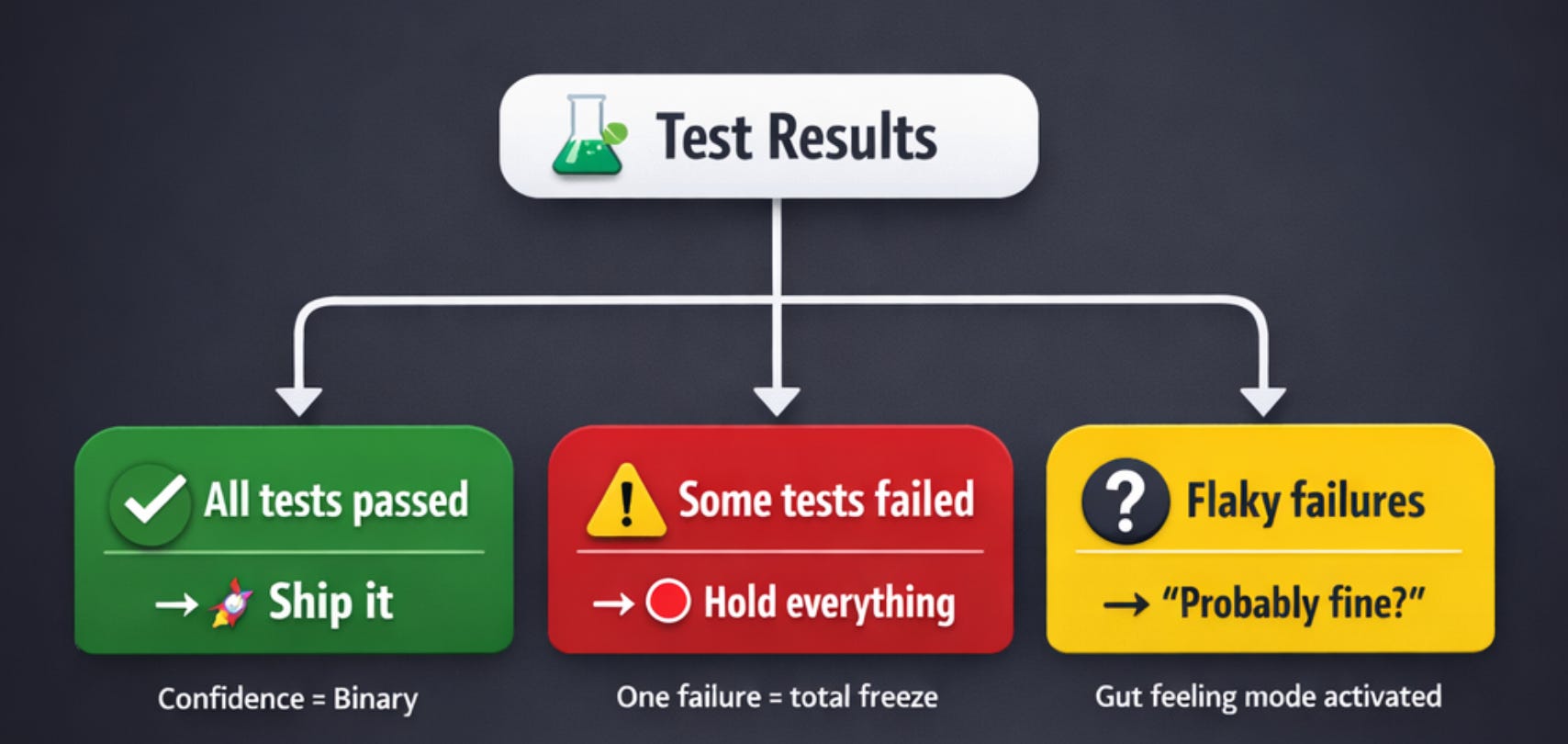
All tests passed → Ship it
Some tests failed → Hold everything
Flaky failures → “Probably fine?”
That’s not quality engineering. That’s checkbox engineering.
So I built something slightly more ambitious: a system that converts test signals into a structured release confidence score.
Not automation of approval. Not replacing QA sign-off. Just structured reasoning at release time.
Here’s what happened.
The Real Problem (It’s Not What You Think)
CI pipelines are noise machines.
A release decision actually depends on a bunch of signals:
How many failures and what type
Historical flakiness patterns
Which components are impacted
The risk profile of this specific release
But these signals live in completely different places. Test reports. Jira tickets. Git diffs. Random Slack threads at 4 PM on Friday.
Humans manually synthesize all of this under time pressure.
That’s the actual bottleneck.
After 14 years of watching release meetings, I can tell you: the problem isn’t that we don’t have enough data. It’s that we have too much, and no structured way to think about it.
What I Explicitly Did NOT Build
This matters more than what I built.
I avoided:
Auto-blocking releases
Auto-approving builds
Touching the pipeline itself
The system produces a structured “confidence narrative.” That’s it.
Humans still make the call.
Why? Because I’ve seen what happens when automation starts making release decisions without context. It becomes this thing that everyone routes around. You end up with more problems than you started with.
The Inputs (Nothing Magical)
For each release candidate, I aggregated:
Total tests run
Failure categories (using my earlier failure explainer)
Flaky test history
Code change size
Impacted services
Recent defect trends
Just structured signals. Nothing you don’t already have.
The Key Design Choice That Changed Everything
Instead of asking “Is this release safe?”
I reframed it:
What are the risk drivers?
What failure types increased compared to baseline?
Are failures clustered in critical paths?
Is this regression pattern consistent with the change size?
That framing changed everything.
Here’s what I learned: LLMs are actually pretty good at structured synthesis. They’re terrible at binary judgment.
So I stopped asking it to judge and started asking it to synthesize.
How the System Actually Works
The workflow is straightforward:
Aggregate structured release data
Normalize it (same principle as the failure explainer—clean inputs matter)
Send it to the LLM with very specific constraints:
Highlight risk clusters
Compare against historical baseline
Avoid absolute statements
Explicitly state uncertainty
The output format:
Risk factors identified
Stability signals
Areas requiring human review
Suggested confidence band (High / Moderate / Low)
Not a verdict. A reasoning summary.
The kind of thing that would take a human 20 minutes to compile, but the LLM does in seconds.
What Surprised Me
Small releases sometimes got flagged as low confidence.
Large releases sometimes scored higher.
This felt wrong at first. Surely bigger changes = more risk?
But then I looked closer:
Change size doesn’t equal risk
Failure type matters way more than failure count
Clustering predicts instability better than totals
A 5-line config change that breaks auth is riskier than a 500-line refactor in a well-tested util library.
This completely changed how I think about regression signals.
What Broke (Learn From My Mistakes)
The first version over-weighted failure count.
It would punish releases for:
Known flaky tests that nobody cares about
Low-impact modules that don’t affect users
So I introduced:
Historical flakiness discounting
Service criticality weighting
Regression vs known issue differentiation
The system improved immediately.
Not because I changed the model. Because I changed the framing.
Same lesson as the failure explainer: clean inputs and good prompts beat smart models.
Where This Actually Helps
This system is useful for:
QE leads making decisions under time pressure
Engineering managers reviewing release health
Cross-team alignment discussions
Avoiding those emotional “ship vs don’t ship” debates at 5 PM
It creates structured conversation instead of gut feelings and arguments.
That’s valuable.
What This Is NOT
Let me be very clear.
This is not:
A replacement for QA
A safety certification
A risk oracle
It is: a reasoning layer over noisy test systems.
It’s the same philosophy as the failure explainer. It doesn’t make decisions. It helps humans make better decisions, faster.
The Pattern I Keep Seeing
Both the failure explainer and this confidence engine follow the same principle:
Don’t automate judgment. Automate synthesis.
The judgment still needs human context. But the synthesis—pulling together scattered signals, normalizing data, identifying patterns—that’s where AI actually shines.
Every time I’ve tried to push AI further into the “decision” territory, it breaks down. Trust erodes. People route around it.
But when I keep it in the “助理” territory—assistant, not replacement—it works.
If I Were Scaling This
At 10× usage, I’d add:
Release confidence trends over time
Prediction accuracy tracking (did low-confidence releases actually have issues?)
Team-specific risk tolerance calibration
Integration with incident management systems
At 100×, this becomes a release intelligence platform that learns from outcomes and gets better at synthesis.
But I’d never let it auto-approve or auto-block. That line is important.
Final Thought
Look, I’ve been in enough release meetings to know that most of the stress comes from uncertainty, not risk.
“Should we ship this?” is a hard question when you’re staring at 15 test failures, 3 known flaky tests, a code change that touches 12 files, and a deployment window that closes in 2 hours.
This system doesn’t eliminate risk. It eliminates confusion.
And honestly? That’s more valuable than any “smart” automation that tries to make the call for you.